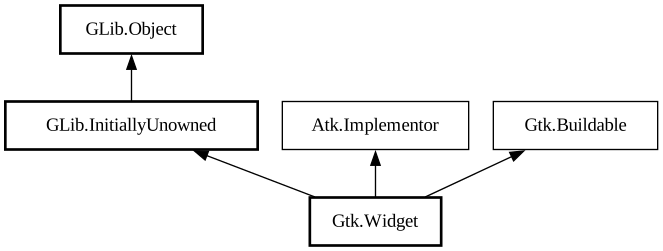
The base class for all widgets.
It manages the widget lifecycle, layout, states and style.
### Minimum and natural size
In order to understand geometry management of widgets in GTK, it is helpful to understand the different terminology surrounding sizing of
widgets.
The two primary terms are: *minimum size* and *natural size*.
As a general rule: the *minimum size* is the size required to display the minimum amount of content in a widget. A widget cannot be
allocated less than the minimum size it requires.
The *natural size* is the amount of content that a widget prefers to display in normal conditions.
A widget may be allocated more than the natural size it prefers, or less, depending on the layout management of its parent container.
What to do when the widget is allocated a different size than the one it prefers is entirely left to the widget implementation: some
widgets decide to add extra room, other widgets may disclose additional content, other widgets may decide to hide content, or show a
different layout entirely.
### Height-for-width Geometry Management
GTK uses a height-for-width (and width-for-height) geometry management system. Height-for-width means that a widget can change how much
vertical space it needs, depending on the amount of horizontal space that it is given (and similar for width-for-height). The most common
example is a label that reflows to fill up the available width, wraps to fewer lines, and therefore needs less height.
Height-for-width geometry management is implemented in GTK by way of two virtual methods:
- [vfunc@Gtk.Widget.get_request_mode]
- [vfunc@Gtk.Widget.measure]
There are some important things to keep in mind when implementing height-for-width and when using it in widget implementations.
If you implement a direct `GtkWidget` subclass that supports height-for-width or width-for-height geometry management for itself or its
child widgets, the [vfunc@Gtk.Widget.get_request_mode] virtual function must be implemented as well and return the widget's preferred
request mode. The default implementation of this virtual function returns gtk_size_request_constant_size
, which means that the widget will only ever get -1 passed as the for_size value to its [vfunc@Gtk.Widget.measure] implementation.
The geometry management system will query a widget hierarchy in only one orientation at a time. When widgets are initially queried for
their minimum sizes it is generally done in two initial passes in the [enum@Gtk.SizeRequestMode] chosen by the toplevel.
For example, when queried in the normal gtk_size_request_height_for_width mode:
First, the default minimum and natural width for each widget in the interface will be computed using [method@Gtk.Widget.measure] with an
orientation of gtk_orientation_horizontal and a for_size of -1. Because the preferred widths for each
widget depend on the preferred widths of their children, this information propagates up the hierarchy, and finally a minimum and natural
width is determined for the entire toplevel. Next, the toplevel will use the minimum width to query for the minimum height contextual to
that width using [method@Gtk.Widget.measure] with an orientation of gtk_orientation_vertical and a
for_size of the just computed width. This will also be a highly recursive operation. The minimum height for the minimum width is normally
used to set the minimum size constraint on the toplevel.
After the toplevel window has initially requested its size in both dimensions it can go on to allocate itself a reasonable size (or a
size previously specified with [method@Gtk.Window.set_default_size]). During the recursive allocation process it’s important to note
that request cycles will be recursively executed while widgets allocate their children. Each widget, once allocated a size, will go on to
first share the space in one orientation among its children and then request each child's height for its target allocated width or its
width for allocated height, depending. In this way a widget will typically be requested its size a number of times before actually being
allocated a size. The size a widget is finally allocated can of course differ from the size it has requested. For this reason, `GtkWidget`
caches a small number of results to avoid re-querying for the same sizes in one allocation cycle.
If a widget does move content around to intelligently use up the allocated size then it must support the request in both
`GtkSizeRequestMode`s even if the widget in question only trades sizes in a single orientation.
For instance, a [class@Gtk.Label] that does height-for-width word wrapping will not expect to have [vfunc@Gtk.Widget.measure] with an
orientation of gtk_orientation_vertical called because that call is specific to a width-for-height
request. In this case the label must return the height required for its own minimum possible width. By following this rule any widget that
handles height-for-width or width-for-height requests will always be allocated at least enough space to fit its own content.
Here are some examples of how a gtk_size_request_height_for_width widget generally deals with
width-for-height requests:
```c static void foo_widget_measure (GtkWidget *widget, GtkOrientation orientation, int for_size, int *minimum_size, int
*natural_size, int *minimum_baseline, int *natural_baseline) { if (orientation == GTK_ORIENTATION_HORIZONTAL) { // Calculate minimum
and natural width } else // VERTICAL { if (i_am_in_height_for_width_mode) { int min_width, dummy;
// First, get the minimum width of our widget GTK_WIDGET_GET_CLASS (widget)->measure (widget, GTK_ORIENTATION_HORIZONTAL, -1, &
min_width, &dummy, &dummy, &dummy);
// Now use the minimum width to retrieve the minimum and natural height to display // that width. GTK_WIDGET_GET_CLASS (widget)->
measure (widget, GTK_ORIENTATION_VERTICAL, min_width, minimum_size, natural_size, &dummy, &dummy); } else { // ... some
widgets do both. } } } ```
Often a widget needs to get its own request during size request or allocation. For example, when computing height it may need to also
compute width. Or when deciding how to use an allocation, the widget may need to know its natural size. In these cases, the widget should
be careful to call its virtual methods directly, like in the code example above.
It will not work to use the wrapper function [method@Gtk.Widget.measure] inside your own [vfunc@Gtk.Widget.size_allocate] implementation.
These return a request adjusted by [class@Gtk.SizeGroup], the widget's align and expand flags, as well as its CSS style.
If a widget used the wrappers inside its virtual method implementations, then the adjustments (such as widget margins) would be applied
twice. GTK therefore does not allow this and will warn if you try to do it.
Of course if you are getting the size request for another widget, such as a child widget, you must use [method@Gtk.Widget.measure];
otherwise, you would not properly consider widget margins, [class@Gtk.SizeGroup], and so forth.
GTK also supports baseline vertical alignment of widgets. This means that widgets are positioned such that the typographical baseline of
widgets in the same row are aligned. This happens if a widget supports baselines, has a vertical alignment using baselines, and is inside
a widget that supports baselines and has a natural “row” that it aligns to the baseline, or a baseline assigned to it by the
grandparent.
Baseline alignment support for a widget is also done by the [vfunc@Gtk.Widget.measure] virtual function. It allows you to report both a
minimum and natural size.
If a widget ends up baseline aligned it will be allocated all the space in the parent as if it was
gtk_align_fill, but the selected baseline can be found via [method@Gtk.Widget.get_baseline]. If the baseline has a value other
than -1 you need to align the widget such that the baseline appears at the position.
### GtkWidget as GtkBuildable
The `GtkWidget` implementation of the `GtkBuildable` interface supports various custom elements to specify additional aspects of widgets
that are not directly expressed as properties.
If the widget uses a [class@Gtk.LayoutManager], `GtkWidget` supports a custom `<layout>` element, used to define layout properties:
```xml <object class="GtkGrid" id="my_grid"> <child> <object class="GtkLabel" id="label1"> <property name="label"
>Description</property> <layout> <property name="column">0</property> <property name="row">0<
/property> <property name="row-span">1</property> <property name="column-span">1</property> </layout>
</object> </child> <child> <object class="GtkEntry" id="description_entry"> <layout> <property
name="column">1</property> <property name="row">0</property> <property name="row-span">1</property>
<property name="column-span">1</property> </layout> </object> </child> </object> ```
`GtkWidget` allows style information such as style classes to be associated with widgets, using the custom `<style>` element:
```xml <object class="GtkButton" id="button1"> <style> <class name="my-special-button-class"/> <class
name="dark-button"/> </style> </object> ```
`GtkWidget` allows defining accessibility information, such as properties, relations, and states, using the custom `<accessibility>
` element:
```xml <object class="GtkButton" id="button1"> <accessibility> <property name="label">Download</property> <
relation name="labelled-by">label1</relation> </accessibility> </object> ```
### Building composite widgets from template XML
`GtkWidget `exposes some facilities to automate the procedure of creating composite widgets using "templates".
To create composite widgets with `GtkBuilder` XML, one must associate the interface description with the widget class at class
initialization time using [method@Gtk.WidgetClass.set_template].
The interface description semantics expected in composite template descriptions is slightly different from regular [class@Gtk.Builder]
XML.
Unlike regular interface descriptions, [method@Gtk.WidgetClass.set_template] will expect a `<template>` tag as a direct child of
the toplevel `<interface>` tag. The `<template>` tag must specify the “class” attribute which must be the type name of the
widget. Optionally, the “parent” attribute may be specified to specify the direct parent type of the widget type; this is ignored by
`GtkBuilder` but can be used by UI design tools to introspect what kind of properties and internal children exist for a given type when
the actual type does not exist.
The XML which is contained inside the `<template>` tag behaves as if it were added to the `<object>` tag defining the widget
itself. You may set properties on a widget by inserting `<property>` tags into the `<template>` tag, and also add `<child
>` tags to add children and extend a widget in the normal way you would with `<object>` tags.
Additionally, `<object>` tags can also be added before and after the initial `<template>` tag in the normal way, allowing one
to define auxiliary objects which might be referenced by other widgets declared as children of the `<template>` tag.
Since, unlike the `<object>` tag, the `<template>` tag does not contain an “id” attribute, if you need to refer to the
instance of the object itself that the template will create, simply refer to the template class name in an applicable element content.
Here is an example of a template definition, which includes an example of this in the `<signal>` tag:
```xml <interface> <template class="FooWidget" parent="GtkBox"> <property name="orientation">horizontal</property
> <property name="spacing">4</property> <child> <object class="GtkButton" id="hello_button"> <property
name="label">Hello World</property> <signal name="clicked" handler="hello_button_clicked" object="FooWidget" swapped="yes"/
> </object> </child> <child> <object class="GtkButton" id="goodbye_button"> <property name="label">
Goodbye World</property> </object> </child> </template> </interface> ```
Typically, you'll place the template fragment into a file that is bundled with your project, using `GResource`. In order to load the
template, you need to call [method@Gtk.WidgetClass.set_template_from_resource] from the class initialization of your `GtkWidget` type:
```c static void foo_widget_class_init (FooWidgetClass *klass) { // ...
gtk_widget_class_set_template_from_resource (GTK_WIDGET_CLASS (klass), "/com/example/ui/foowidget.ui"); } ```
You will also need to call [method@Gtk.Widget.init_template] from the instance initialization function:
```c static void foo_widget_init (FooWidget *self) { gtk_widget_init_template (GTK_WIDGET (self));
// Initialize the rest of the widget... } ```
as well as calling [method@Gtk.Widget.dispose_template] from the dispose function:
```c static void foo_widget_dispose (GObject *gobject) { FooWidget *self = FOO_WIDGET (gobject);
// Dispose objects for which you have a reference...
// Clear the template children for this widget type gtk_widget_dispose_template (GTK_WIDGET (self), FOO_TYPE_WIDGET);
G_OBJECT_CLASS (foo_widget_parent_class)->dispose (gobject); } ```
You can access widgets defined in the template using the [method@Gtk.Widget.get_template_child] function, but you will typically declare
a pointer in the instance private data structure of your type using the same name as the widget in the template definition, and call [
method@Gtk.WidgetClass.bind_template_child_full] (or one of its wrapper macros [func@Gtk.widget_class_bind_template_child] and [
func@Gtk.widget_class_bind_template_child_private]) with that name, e.g.
```c typedef struct { GtkWidget *hello_button; GtkWidget *goodbye_button; } FooWidgetPrivate;
G_DEFINE_TYPE_WITH_PRIVATE (FooWidget, foo_widget, GTK_TYPE_BOX)
static void foo_widget_dispose (GObject *gobject) { gtk_widget_dispose_template (GTK_WIDGET (gobject), FOO_TYPE_WIDGET);
G_OBJECT_CLASS (foo_widget_parent_class)->dispose (gobject); }
static void foo_widget_class_init (FooWidgetClass *klass) { // ... G_OBJECT_CLASS (klass)->dispose = foo_widget_dispose;
gtk_widget_class_set_template_from_resource (GTK_WIDGET_CLASS (klass), "/com/example/ui/foowidget.ui");
gtk_widget_class_bind_template_child_private (GTK_WIDGET_CLASS (klass), FooWidget, hello_button);
gtk_widget_class_bind_template_child_private (GTK_WIDGET_CLASS (klass), FooWidget, goodbye_button); }
static void foo_widget_init (FooWidget *widget) { gtk_widget_init_template (GTK_WIDGET (widget)); } ```
You can also use [method@Gtk.WidgetClass.bind_template_callback_full] (or is wrapper macro [func@Gtk.widget_class_bind_template_callback]
) to connect a signal callback defined in the template with a function visible in the scope of the class, e.g.
```c // the signal handler has the instance and user data swapped // because of the swapped="yes" attribute in the template XML static
void hello_button_clicked (FooWidget *self, GtkButton *button) { g_print ("Hello, world!\n"); }
static void foo_widget_class_init (FooWidgetClass *klass) { // ... gtk_widget_class_set_template_from_resource (GTK_WIDGET_CLASS (klass
), "/com/example/ui/foowidget.ui"); gtk_widget_class_bind_template_callback (GTK_WIDGET_CLASS (klass), hello_button_clicked); } ```
- public bool activate ()
Activates the widget.
- public void add_accelerator (string accel_signal, AccelGroup accel_group, uint accel_key, ModifierType accel_mods, AccelFlags accel_flags)
Installs an accelerator for this this
in accel_group that causes accel_signal to be emitted if the accelerator is activated.
- public void add_device_events (Device device, EventMask events)
Adds the device events in the bitfield events to the
event mask for this.
- public void add_events (int events)
Adds the events in the bitfield events to the event mask
for this.
- public void add_mnemonic_label (Widget label)
Adds a widget to the list of mnemonic labels for this widget.
- public uint add_tick_callback (owned TickCallback callback)
Queues an animation frame update and adds a callback to be called
before each frame.
- public virtual void adjust_baseline_allocation (ref int baseline)
- public virtual void adjust_baseline_request (ref int minimum_baseline, ref int natural_baseline)
- public virtual void adjust_size_allocation (Orientation orientation, ref int minimum_size, ref int natural_size, ref int allocated_pos, ref int allocated_size)
Convert an initial size allocation assigned by a
Container using
size_allocate, into an actual size allocation to be used by the widget.
- public virtual void adjust_size_request (Orientation orientation, ref int minimum_size, ref int natural_size)
Convert an initial size request from a widget's
SizeRequestMode virtual method implementations into a size request to be used by
parent containers in laying out the widget.
- public class void bind_template_callback_full (string callback_name, Callback callback_symbol)
Associates a name to be used in GtkBuilder XML with a symbol.
- public class void bind_template_child_full (string name, bool internal_child, ssize_t struct_offset)
Assigns an object declared in the class template XML to be set to a
location on a freshly built instance’s private data, or alternatively accessible via [method@Gtk.
- public bool child_focus (DirectionType direction)
Called by widgets as the user moves around the window using keyboard
shortcuts.
- public void class_path (out uint path_length, out string path, out string path_reversed)
Same as path, but
always uses the name of a widget’s type, never uses a custom name set with gtk_widget_set_name.
- public bool compute_expand (Orientation orientation)
Computes whether a parent widget should give this widget extra space
when possible.
- public virtual void compute_expand_internal (out bool hexpand_p, out bool vexpand_p)
- public Context create_pango_context ()
Creates a new `PangoContext` that is configured for the widget.
- public Layout create_pango_layout (string? text)
Creates a new `PangoLayout` that is configured for the widget.
- public void destroyed (ref unowned Widget widget_pointer)
This function sets *widget_pointer to
null if widget_pointer != null.
- public bool device_is_shadowed (Device device)
Returns true if device
has been shadowed by a GTK+ device grab on another widget, so it would stop sending events to this.
- public virtual void dispatch_child_properties_changed (ParamSpec[] pspecs)
Seldomly overidden.
- public void draw_to_cairo_context (Context cr)
- public void ensure_style ()
Ensures that this has a style (
this->style).
- public void error_bell ()
Notifies the user about an input-related error on the widget.
- public class unowned ParamSpec find_style_property (string property_name)
Finds a style property of a widget class by name.
- public void freeze_child_notify ()
- public virtual unowned Object get_accessible ()
Returns the accessible object that describes the widget to an
assistive technology.
- public unowned ActionGroup? get_action_group (string prefix)
Retrieves the
ActionGroup that was registered using prefix.
- public int get_allocated_baseline ()
Returns the baseline that has currently been allocated to the widget.
- public int get_allocated_height ()
Returns the height that has currently been allocated to the widget.
- public void get_allocated_size (out Allocation allocation, out int baseline)
Retrieves the widget’s allocated size.
- public int get_allocated_width ()
Returns the width that has currently been allocated to the widget.
- public void get_allocation (out Allocation allocation)
Retrieves the widget’s allocation.
- public unowned Widget? get_ancestor (Type widget_type)
Gets the first ancestor of the widget with type widget_type
.
- public bool get_app_paintable ()
Determines whether the application intends to draw on the widget in an
draw handler.
- public bool get_can_default ()
Determines whether this can be a
default widget.
- public bool get_can_focus ()
Determines whether the input focus can enter the widget or any of its
children.
- public void get_child_requisition (out Requisition requisition)
This function is only for use in widget implementations.
- public bool get_child_visible ()
Gets the value set with [method@Gtk.
- public void get_clip (out Allocation clip)
Retrieves the widget’s clip area.
- public unowned Clipboard get_clipboard (Atom selection)
Gets the clipboard object for the widget.
- public string get_composite_name ()
Obtains the composite name of a widget.
- public class unowned string get_css_name ()
Gets the name used by this class for matching in CSS code.
- public bool get_device_enabled (Device device)
Returns whether device can interact with
this and its children.
- public EventMask get_device_events (Device device)
Returns the events mask for the widget corresponding to an specific
device.
- public TextDirection get_direction ()
Gets the reading direction for the widget.
- public unowned Display get_display ()
Get the display for the window that the widget belongs to.
- public bool get_double_buffered ()
Determines whether the widget is double buffered.
- public int get_events ()
Returns the event mask (see
EventMask) for the widget.
- public bool get_focus_on_click ()
Returns whether the widget should grab focus when it is clicked with
the mouse.
- public unowned FontMap? get_font_map ()
Gets the font map of the widget.
- public unowned FontOptions? get_font_options ()
Returns the `cairo_font_options_t` of the widget.
- public unowned FrameClock? get_frame_clock ()
Obtains the frame clock for a widget.
- public Align get_halign ()
Gets the horizontal alignment of the widget.
- public bool get_has_tooltip ()
Returns the current value of the `has-tooltip` property.
- public bool get_has_window ()
Determines whether this has a
Window of its own.
- public bool get_hexpand ()
Gets whether the widget would like any available extra horizontal
space.
- public bool get_hexpand_set ()
Gets whether the `hexpand` flag has been explicitly set.
- public bool get_mapped ()
Returns whether the widget is mapped.
- public int get_margin_bottom ()
Gets the bottom margin of the widget.
- public int get_margin_end ()
Gets the end margin of the widget.
- public int get_margin_left ()
- public int get_margin_right ()
- public int get_margin_start ()
Gets the start margin of the widget.
- public int get_margin_top ()
Gets the top margin of the widget.
- public ModifierType get_modifier_mask (ModifierIntent intent)
Returns the modifier mask the this
’s windowing system backend uses for a particular purpose.
- public unowned RcStyle get_modifier_style ()
Returns the current modifier style for the widget.
- public bool get_no_show_all ()
Returns the current value of the
no_show_all property, which determines whether calls to
show_all will affect this widget.
- public double get_opacity ()
Fetches the requested opacity for the widget.
- public unowned Context get_pango_context ()
Gets a `PangoContext` that is configured for the widget.
- public unowned Container? get_parent ()
Returns the parent widget of the widget.
- public unowned Window? get_parent_window ()
Gets this’s parent window, or
null if it does not have one.
- public unowned WidgetPath get_path ()
Returns the WidgetPath
representing this, if the widget is not connected to a toplevel widget, a partial path will be
created.
- public void get_pointer (out int x, out int y)
Obtains the location of the mouse pointer in widget coordinates.
- public virtual void get_preferred_height (out int minimum_height, out int natural_height)
Retrieves a widget’s initial minimum and natural height.
- public virtual void get_preferred_height_and_baseline_for_width (int width, out int minimum_height, out int natural_height, out int minimum_baseline, out int natural_baseline)
Retrieves a widget’s minimum and natural height and the
corresponding baselines if it would be given the specified width, or the default height if width is -1.
- public virtual void get_preferred_height_for_width (int width, out int minimum_height, out int natural_height)
Retrieves a widget’s minimum and natural height if it would be given
the specified width.
- public virtual void get_preferred_height_for_width_internal (int width, out int minimum_height, out int natural_height)
- public virtual void get_preferred_height_internal (out int minimum_height, out int natural_height)
- public void get_preferred_size (out Requisition minimum_size, out Requisition natural_size)
Retrieves the minimum and natural size of a widget, taking into
account the widget’s preference for height-for-width management.
- public virtual void get_preferred_width (out int minimum_width, out int natural_width)
Retrieves a widget’s initial minimum and natural width.
- public virtual void get_preferred_width_for_height (int height, out int minimum_width, out int natural_width)
Retrieves a widget’s minimum and natural width if it would be given
the specified height.
- public virtual void get_preferred_width_for_height_internal (int height, out int minimum_width, out int natural_width)
- public virtual void get_preferred_width_internal (out int minimum_width, out int natural_width)
- public bool get_realized ()
Determines whether the widget is realized.
- public bool get_receives_default ()
Determines whether the widget is always treated as the default widget
within its toplevel when it has the focus, even if another widget is the default.
- public virtual SizeRequestMode get_request_mode ()
Gets whether the widget prefers a height-for-width layout or a
width-for-height layout.
- public Requisition get_requisition ()
Retrieves the widget’s requisition.
- public unowned Window get_root_window ()
Get the root window where this widget is located.
- public int get_scale_factor ()
Retrieves the internal scale factor that maps from window coordinates
to the actual device pixels.
- public unowned Screen get_screen ()
Get the Screen
from the toplevel window associated with this widget.
- public bool get_sensitive ()
Returns the widget’s sensitivity.
- public unowned Settings get_settings ()
Gets the settings object holding the settings used for the widget.
- public void get_size_request (out int width, out int height)
Gets the size request that was explicitly set for the widget.
- public StateType get_state ()
Returns the widget’s state.
- public StateFlags get_state_flags ()
Returns the widget state as a flag set.
- public unowned Style get_style ()
Simply an accessor function that returns
this->style.
- public unowned StyleContext get_style_context ()
Returns the style context associated to the widget.
- public bool get_support_multidevice ()
Returns true if
this is multiple pointer aware.
- public unowned Object get_template_child (Type widget_type, string name)
Fetches an object build from the template XML for widget_type
in the widget.
- public string? get_tooltip_markup ()
Gets the contents of the tooltip for the widget.
- public string? get_tooltip_text ()
Gets the contents of the tooltip for the widget.
- public unowned Window get_tooltip_window ()
Returns the Window of the
current tooltip.
- public unowned Widget get_toplevel ()
This function returns the topmost widget in the container hierarchy
this is a part of.
- public Align get_valign ()
Gets the vertical alignment of the widget.
- public Align get_valign_with_baseline ()
Gets the value of the
valign property, including gtk_align_baseline.
- public bool get_vexpand ()
Gets whether the widget would like any available extra vertical space.
- public bool get_vexpand_set ()
Gets whether the `vexpand` flag has been explicitly set.
- public bool get_visible ()
Determines whether the widget is visible.
- public unowned Visual get_visual ()
Gets the visual that will be used to render
this.
- public unowned Window? get_window ()
Returns the widget’s window if it is realized,
null otherwise
- public void grab_default ()
Causes this to become the default
widget.
- public bool has_grab ()
Determines whether the widget is currently grabbing events, so it is
the only widget receiving input events (keyboard and mouse).
- public bool has_rc_style ()
Determines if the widget style has been looked up through the rc
mechanism.
- public bool has_screen ()
Checks whether there is a
Screen is associated with this widget.
- public bool has_visible_focus ()
Determines if the widget should show a visible indication that it has
the global input focus.
- public bool hide_on_delete ()
- public bool in_destruction ()
Returns whether the widget is currently being destroyed.
- public void init_template ()
Creates and initializes child widgets defined in templates.
- public void input_shape_combine_region (Region? region)
Sets an input shape for this widget’s GDK window.
- public void insert_action_group (string name, ActionGroup? group)
Inserts an action group into the widget's actions.
- public class void install_style_property (ParamSpec pspec)
Installs a style property on a widget class.
- public class void install_style_property_parser (ParamSpec pspec, RcPropertyParser parser)
Installs a style property on a widget class.
- public bool intersect (Rectangle area, out Rectangle? intersection = null)
Computes the intersection of a this
’s area and area, storing the intersection in intersection, and returns true
if there was an intersection.
- public bool is_ancestor (Widget ancestor)
Determines whether the widget is a descendent of ancestor
.
- public bool is_composited ()
Whether this can rely on having its
alpha channel drawn correctly.
- public bool is_drawable ()
Determines whether the widget can be drawn to.
- public bool is_sensitive ()
Returns the widget’s effective sensitivity.
- public bool is_toplevel ()
Determines whether this is a
toplevel widget.
- public bool is_visible ()
Determines whether the widget and all its parents are marked as
visible.
- public List<unowned Closure> list_accel_closures ()
- public (unowned string)[] list_action_prefixes ()
Retrieves a null-terminated array of
strings containing the prefixes of ActionGroup's available to
this.
- public List<unowned Widget> list_mnemonic_labels ()
Returns the widgets for which this widget is the target of a mnemonic.
- public class (unowned ParamSpec)[] list_style_properties ()
Returns all style properties of a widget class.
- public void modify_base (StateType state, Color? color)
Sets the base color for a widget in a particular state.
- public void modify_bg (StateType state, Color? color)
Sets the background color for a widget in a particular state.
- public void modify_cursor (Color? primary, Color? secondary)
Sets the cursor color to use in a widget, overriding the
Widget cursor-color and secondary-cursor-color style properties.
- public void modify_fg (StateType state, Color? color)
Sets the foreground color for a widget in a particular state.
- public void modify_font (FontDescription? font_desc)
Sets the font to use for a widget.
- public void modify_style (RcStyle style)
Modifies style values on the widget.
- public void modify_text (StateType state, Color? color)
Sets the text color for a widget in a particular state.
- public void override_background_color (StateFlags state, RGBA? color)
Sets the background color to use for a widget.
- public void override_color (StateFlags state, RGBA? color)
Sets the color to use for a widget.
- public void override_cursor (RGBA? cursor, RGBA? secondary_cursor)
Sets the cursor color to use in a widget, overriding the cursor-color
and secondary-cursor-color style properties.
- public void override_font (FontDescription? font_desc)
Sets the font to use for a widget.
- public void override_symbolic_color (string name, RGBA? color)
Sets a symbolic color for a widget.
- public void path (out uint path_length, out string path, out string path_reversed)
Obtains the full path to this.
- public void queue_allocate ()
Flags the widget for a rerun of the [vfunc@Gtk.
- public void queue_compute_expand ()
Mark this as needing to recompute
its expand flags.
- public void queue_draw ()
Schedules this widget to be redrawn.
- public void queue_draw_area (int x, int y, int width, int height)
Convenience function that calls
queue_draw_region on the region created from the given
coordinates.
- public virtual void queue_draw_region (Region region)
Invalidates the area of this defined
by region by calling invalidate_region on the
widget’s window and all its child windows.
- public void queue_resize ()
Flags a widget to have its size renegotiated.
- public void queue_resize_no_redraw ()
This function works like
queue_resize, except that the widget is not invalidated.
- public Region region_intersect (Region region)
Computes the intersection of a this
’s area and region, returning the intersection.
- public void register_window (Window window)
Registers a Window
with the widget and sets it up so that the widget receives events for it.
- public bool remove_accelerator (AccelGroup accel_group, uint accel_key, ModifierType accel_mods)
Removes an accelerator from this,
previously installed with add_accelerator.
- public void remove_mnemonic_label (Widget label)
Removes a widget from the list of mnemonic labels for this widget.
- public void remove_tick_callback (uint id)
Removes a tick callback previously registered with [method@Gtk.
- public Pixbuf? render_icon (string stock_id, IconSize size, string? detail)
A convenience function that uses the theme settings for
this to look up stock_id and render it to a pixbuf.
- public Pixbuf? render_icon_pixbuf (string stock_id, IconSize size)
A convenience function that uses the theme engine and style settings
for this to look up stock_id and render it to a pixbuf.
- public void reparent (Widget new_parent)
Moves a widget from one
Container to another, handling reference count issues to avoid destroying the
widget.
- public void reset_rc_styles ()
Reset the styles of this and all
descendents, so when they are looked up again, they get the correct values for the currently loaded RC file settings.
- public void reset_style ()
Updates the style context of this
and all descendants by updating its widget path.
- public int send_expose (Event event)
Very rarely-used function.
- public bool send_focus_change (Event event)
Sends the focus change event to
this
- public void set_accel_path (string? accel_path, AccelGroup? accel_group)
Given an accelerator group, accel_group, and an
accelerator path, accel_path, sets up an accelerator in accel_group so whenever the key binding that is
defined for accel_path is pressed, this will be activated.
- public class void set_accessible_role (Role role)
Sets the accessible role used by the given widget class.
- public class void set_accessible_type (Type type)
Sets the type to be used for creating accessibles for widgets of
this.
- public void set_allocation (Allocation allocation)
Sets the widget’s allocation.
- public void set_app_paintable (bool app_paintable)
Sets whether the application intends to draw on the widget in an
draw handler.
- public void set_can_default (bool can_default)
Specifies whether this can be a
default widget.
- public void set_can_focus (bool can_focus)
Sets whether the input focus can enter the widget or any of its
children.
- public void set_child_visible (bool is_visible)
Sets whether the widget should be mapped along with its parent.
- public void set_clip (Allocation clip)
Sets the widget’s clip.
- public void set_composite_name (string name)
Sets a widgets composite name.
- public class void set_connect_func (owned BuilderConnectFunc connect_func)
For use in language bindings, this will override the default
BuilderConnectFunc to be used when parsing GtkBuilder XML from this
class’s template data.
- public class void set_css_name (string name)
Sets the name to be used for CSS matching of widgets.
- public void set_device_enabled (Device device, bool enabled)
Enables or disables a
Device to interact with this and all
its children.
- public void set_device_events (Device device, EventMask events)
Sets the device event mask (see
EventMask) for a widget.
- public void set_direction (TextDirection dir)
Sets the reading direction on the widget.
- public void set_double_buffered (bool double_buffered)
Widgets are double buffered by default; you can use this function to
turn off the buffering.
- public void set_events (int events)
Sets the event mask (see
EventMask) for a widget.
- public void set_focus_on_click (bool focus_on_click)
Sets whether the widget should grab focus when it is clicked with the
mouse.
- public void set_font_map (FontMap? font_map)
Sets the font map to use for text rendering in the widget.
- public void set_font_options (FontOptions? options)
Sets the `cairo_font_options_t` used for text rendering in the widget.
- public void set_halign (Align align)
Sets the horizontal alignment of the widget.
- public void set_has_tooltip (bool has_tooltip)
Sets the `has-tooltip` property on the widget.
- public void set_has_window (bool has_window)
Specifies whether this has a
Window of its own.
- public void set_hexpand (bool expand)
Sets whether the widget would like any available extra horizontal
space.
- public void set_hexpand_set (bool @set)
Sets whether the hexpand flag will be used.
- public void set_mapped (bool mapped)
Marks the widget as being mapped.
- public void set_margin_bottom (int margin)
Sets the bottom margin of the widget.
- public void set_margin_end (int margin)
Sets the end margin of the widget.
- public void set_margin_left (int margin)
Sets the left margin of this.
- public void set_margin_right (int margin)
Sets the right margin of this.
- public void set_margin_start (int margin)
Sets the start margin of the widget.
- public void set_margin_top (int margin)
Sets the top margin of the widget.
- public void set_no_show_all (bool no_show_all)
Sets the
no_show_all property, which determines whether calls to show_all
will affect this widget.
- public void set_opacity (double opacity)
Requests the widget to be rendered partially transparent.
- public void set_parent (Container parent)
Sets the parent widget of the widget.
- public void set_parent_window (Window parent_window)
Sets a non default parent window for this
.
- public void set_realized (bool realized)
Marks the widget as being realized.
- public void set_receives_default (bool receives_default)
Sets whether the widget will be treated as the default widget within
its toplevel when it has the focus, even if another widget is the default.
- public void set_redraw_on_allocate (bool redraw_on_allocate)
Sets whether the entire widget is queued for drawing when its size
allocation changes.
- public void set_sensitive (bool sensitive)
Sets the sensitivity of the widget.
- public void set_size_request (int width, int height)
Sets the minimum size of the widget.
- public void set_state (StateType state)
This function is for use in widget implementations.
- public void set_state_flags (StateFlags flags, bool clear)
Turns on flag values in the current widget state.
- public void set_style (Style? style)
Used to set the Style for a
widget (this->style).
- public void set_support_multidevice (bool support_multidevice)
Enables or disables multiple pointer awareness.
- public class void set_template (Bytes template_bytes)
This should be called at class initialization time to specify the
`GtkBuilder` XML to be used to extend a widget.
- public class void set_template_from_resource (string resource_name)
A convenience function that calls [method@Gtk.
- public void set_tooltip_markup (string? markup)
Sets the contents of the tooltip for widget.
- public void set_tooltip_text (string? text)
Sets the contents of the tooltip for the widget.
- public void set_tooltip_window (Window? custom_window)
Replaces the default window used for displaying tooltips with
custom_window.
- public void set_valign (Align align)
Sets the vertical alignment of the widget.
- public void set_vexpand (bool expand)
Sets whether the widget would like any available extra vertical space.
- public void set_vexpand_set (bool @set)
Sets whether the vexpand flag will be used.
- public void set_visible (bool visible)
Sets the visibility state of this.
- public void set_visual (Visual? visual)
Sets the visual that should be used for by widget and its children for
creating Windows.
- public void set_window (owned Window window)
Sets a widget’s window.
- public void shape_combine_region (Region? region)
Sets a shape for this widget’s GDK window.
- public virtual void show_all ()
Recursively shows a widget, and any child widgets (if the widget is a
container).
- public void show_now ()
Shows a widget.
- public void size_allocate_with_baseline (Allocation allocation, int baseline)
This function is only used by
Container subclasses, to assign a size, position and (optionally) baseline to
their child widgets.
- public Requisition size_request ()
This function is typically used when implementing a
Container subclass.
- public void style_attach ()
This function attaches the widget’s
Style to the widget's Window.
- public void style_get (...)
Gets the values of a multiple style properties of
this.
- public void style_get_property (string property_name, ref Value value)
Gets the value of a style property of this
.
- public void style_get_valist (string first_property_name, va_list var_args)
- public void thaw_child_notify ()
- public bool translate_coordinates (Widget dest_widget, int src_x, int src_y, out int dest_x, out int dest_y)
Translates coordinates relative to this
’s allocation to coordinates relative to dest_widget’s allocations.
- public void trigger_tooltip_query ()
Triggers a tooltip query on the display of the widget.
- public void unparent ()
Removes this from its parent.
- public void unregister_window (Window window)
- public void unset_state_flags (StateFlags flags)
Turns off flag values for the current widget state.