[ CCode ( type_id = "tracker_endpoint_get_type ()" ) ]
public abstract class Endpoint : Object
Endpoint
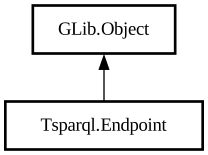
Object Hierarchy:
Description:
`TrackerEndpoint` is a helper object to make RDF triple stores represented by a [class@SparqlConnection] publicly available to other processes/hosts.
This is a base abstract object, see [class@EndpointDBus] to make RDF triple stores available to other processes in the same machine, and [class@EndpointHttp] to make it available to other hosts in the network.
When the RDF triple store represented by a [class@SparqlConnection] is made public this way, other peers may connect to the database using [ctor@SparqlConnection.bus_new] or [ctor@SparqlConnection.remote_new] to access this endpoint exclusively, or they may use the `SERVICE <uri> { ... }` SPARQL syntax from their own [class@SparqlConnection]s to expand their data set.
By default, and as long as the underlying [class@SparqlConnection] allows SPARQL updates and RDF graph changes, endpoints will allow updates and modifications to happen through them. Use [method@Endpoint.set_readonly] to change this behavior.
By default, endpoints allow access to every RDF graph in the triple store and further external SPARQL endpoints to the queries performed on it. Use [method@Endpoint.set_allowed_graphs] and [method@Endpoint.set_allowed_services] to change this behavior. Users do not typically need to do this for D-Bus endpoints, as these do already have a layer of protection with the Tracker portal. This is the mechanism used by the portal itself. This access control API may not interoperate with other SPARQL endpoint implementations than Tracker.
All known sub-classes:
Namespace: Tsparql
Package: tinysparql-3.0
Content:
Properties:
Creation methods:
Methods:
Inherited Members:
All known members inherited from class GLib.Object