[ CCode ( type_id = "tracker_endpoint_dbus_get_type ()" ) ]
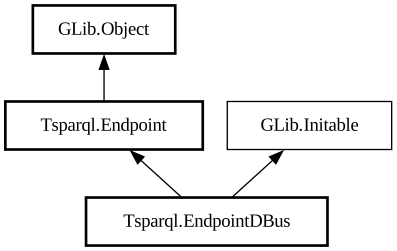
public class EndpointDBus : Endpoint, Initable
EndpointDBus
Object Hierarchy:
Description:
`TrackerEndpointDBus` makes the RDF data in a [class@SparqlConnection] accessible to other processes via DBus.
This object is a [class@Endpoint] subclass that exports a [class@SparqlConnection] so its RDF data is accessible to other processes through the given [class@Gio.DBusConnection].
```c // This process already has org.example.Endpoint bus name endpoint = tracker_endpoint_dbus_new (sparql_connection, dbus_connection, NULL, NULL, &error);
// From another process connection = tracker_sparql_connection_bus_new ("org.example.Endpoint", NULL, dbus_connection, &error); ```
The `TrackerEndpointDBus` will manage a DBus object at the given path with the `org.freedesktop.Tracker3.Endpoint` interface, if no path is given the object will be at the default `/org/freedesktop/Tracker3/Endpoint` location.
Access to D-Bus endpoints may be managed via the [signal@EndpointDBus:TrackerEndpointDBus:block-call] signal, the boolean
return value expressing whether the request is blocked or not. Inspection of the requester address is left up to the user. The default
value allows all requests independently of their provenance.
However, moderating access to D-Bus interfaces is typically not necessary in user code, as access to public D-Bus endpoints will be transparently managed through the Tracker portal service for applications sandboxed via XDG portals. These already have access to D-Bus SPARQL endpoints and their data naturally filtered as defined in the application manifest.
A `TrackerEndpointDBus` may be created on a different thread/main context from the one that created [class@SparqlConnection].
Namespace: Tsparql
Package: tinysparql-3.0
Content:
Properties:
Creation methods:
Signals:
Inherited Members:
All known members inherited from class Tsparql.Endpoint
All known members inherited from class GLib.Object
All known members inherited from interface GLib.Initable