[ CCode ( type_id = "tracker_endpoint_http_get_type ()" ) ]
[ Version ( since = "3.1" ) ]
public class EndpointHttp : Endpoint, Initable
EndpointHttp
Object Hierarchy:
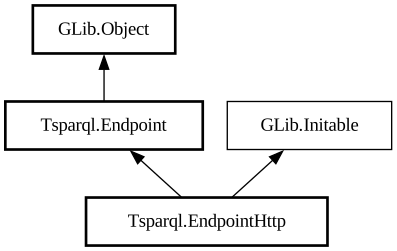
Description:
`TrackerEndpointHttp` makes the RDF data in a [class@SparqlConnection] accessible to other hosts via HTTP.
This object is a [class@Endpoint] subclass that exports a [class@SparqlConnection] so its RDF data is accessible via HTTP requests on the given port. This endpoint implementation is compliant with the SPARQL protocol specifications and may interoperate with other implementations.
```c // This host has "example.local" hostname endpoint = tracker_endpoint_http_new (sparql_connection, 8080, tls_certificate, NULL, &error);
// From another host connection = tracker_sparql_connection_remote_new ("http://example.local:8080/sparql"); ```
Access to HTTP endpoints may be managed via the [signal@EndpointHttp:TrackerEndpointHttp:block-remote-addresss] signal, the
boolean return value expressing whether the connection is blocked or not. Inspection of the requester address is left up to the user. The
default value allows all requests independently of their provenance, users are encouraged to add a handler.
If the provided [class@Gio.TlsCertificate] is null, the endpoint will allow plain HTTP connections. Users are encouraged to provide a certificate in order to use HTTPS.
As a security measure, and in compliance specifications, the HTTP endpoint does not handle database updates or modifications in any way. The database content is considered to be entirely managed by the process that creates the HTTP endpoint and owns the [ class@SparqlConnection].
A `TrackerEndpointHttp` may be created on a different thread/main context from the one that created [class@SparqlConnection].
Namespace: Tsparql
Package: tinysparql-3.0
Content:
Properties:
Creation methods:
Signals:
Inherited Members:
All known members inherited from class Tsparql.Endpoint
All known members inherited from class GLib.Object
All known members inherited from interface GLib.Initable