[ CCode ( type_id = "soup_server_get_type ()" ) ]
public class Server : Object
Server
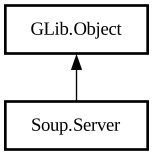
Object Hierarchy:
Description:
[class@Server] provides a basic implementation of an HTTP server.
The recommended usage of this server is for internal use, tasks like a mock server for tests, a private service for IPC, etc. It is not recommended to be exposed to untrusted clients as it may be vulnerable to denial of service attacks or other exploits.
To begin, create a server using [ctor@Server.new]. Add at least one handler by calling [method@Server.add_handler] or [ method@Server.add_early_handler]; the handler will be called to process any requests underneath the path you pass. (If you want all requests to go to the same handler, just pass "/" (or null) for the path.)
When a new connection is accepted (or a new request is started on an existing persistent connection), the [class@Server] will emit [
signal@Server:SoupServer:request-started] and then begin processing the request as described below, but note that once the
message is assigned a status-code, then callbacks after that point will be skipped. Note also that it is not defined when the callbacks
happen relative to various [class@ServerMessage] signals.
Once the headers have been read, [class@Server] will check if there is a [class@AuthDomain] `(qv)` covering the Request-URI; if so, and if the message does not contain suitable authorization, then the [class@AuthDomain] will set a status of soup_status_unauthorized on the message.
After checking for authorization, [class@Server] will look for "early" handlers (added with [method@Server.add_early_handler]) matching the Request-URI. If one is found, it will be run; in particular, this can be used to connect to signals to do a streaming read of the request body.
(At this point, if the request headers contain `Expect: 100-continue`, and a status code has been set, then [class@Server] will skip the remaining steps and return the response. If the request headers contain `Expect: 100-continue` and no status code has been set, [ class@Server] will return a soup_status_continue status before continuing.)
The server will then read in the response body (if present). At this point, if there are no handlers at all defined for the Request-URI, then the server will return soup_status_not_found to the client.
Otherwise (assuming no previous step assigned a status to the message) any "normal" handlers (added with [method@Server.add_handler]) for the message's Request-URI will be run.
Then, if the path has a WebSocket handler registered (and has not yet been assigned a status), [class@Server] will attempt to validate the WebSocket handshake, filling in the response and setting a status of soup_status_switching_protocols or soup_status_bad_request accordingly.
If the message still has no status code at this point (and has not been paused with [method@ServerMessage.pause]), then it will be given a status of soup_status_internal_server_error (because at least one handler ran, but returned without assigning a status).
Finally, the server will emit [signal@Server:SoupServer:request-finished] (or [signal@Server:
SoupServer:request-aborted] if an I/O error occurred before handling was completed).
If you want to handle the special "*" URI (eg, "OPTIONS *"), you must explicitly register a handler for "*"; the default handler will not be used for that case.
If you want to process https connections in addition to (or instead of) http connections, you can set the [ property@Server:tls-certificate] property.
Once the server is set up, make one or more calls to [method@Server.listen], [method@Server.listen_local], or [method@Server.listen_all] to tell it where to listen for connections. (All ports on a [class@Server] use the same handlers; if you need to handle some ports differently, such as returning different data for http and https, you'll need to create multiple [class@Server]s, or else check the passed-in URI in the handler function.).
[class@Server] will begin processing connections as soon as you return to (or start) the main loop for the current thread-default [ struct@GLib.MainContext].
Namespace: Soup
Package: libsoup-3.0
Content:
Properties:
Creation methods:
Methods:
Signals:
Inherited Members:
All known members inherited from class GLib.Object