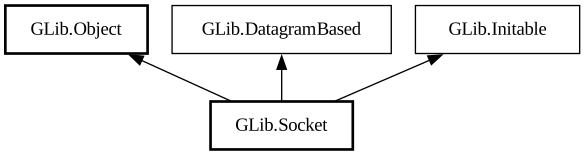
A `GSocket` is a low-level networking primitive.
It is a more or less direct mapping of the BSD socket API in a portable GObject based API. It supports both the UNIX socket
implementations and winsock2 on Windows.
`GSocket` is the platform independent base upon which the higher level network primitives are based. Applications are not typically meant
to use it directly, but rather through classes like [class@Gio.SocketClient], [class@Gio.SocketService] and [class@Gio.SocketConnection].
However there may be cases where direct use of `GSocket` is useful.
`GSocket` implements the [iface@Gio.Initable] interface, so if it is manually constructed by e.g. [ctor@GObject.Object.new] you must call
[method@Gio.Initable.init] and check the results before using the object. This is done automatically in [ctor@Gio.Socket.new] and [
ctor@Gio.Socket.new_from_fd], so these functions can return `NULL`.
Sockets operate in two general modes, blocking or non-blocking. When in blocking mode all operations (which don’t take an explicit
blocking parameter) block until the requested operation is finished or there is an error. In non-blocking mode all calls that would block
return immediately with a `G_IO_ERROR_WOULD_BLOCK` error. To know when a call would successfully run you can call [
method@Gio.Socket.condition_check], or [method@Gio.Socket.condition_wait]. You can also use [method@Gio.Socket.create_source] and attach
it to a [type@GLib.MainContext] to get callbacks when I/O is possible. Note that all sockets are always set to non blocking mode in the
system, and blocking mode is emulated in `GSocket`.
When working in non-blocking mode applications should always be able to handle getting a `G_IO_ERROR_WOULD_BLOCK` error even when some
other function said that I/O was possible. This can easily happen in case of a race condition in the application, but it can also happen
for other reasons. For instance, on Windows a socket is always seen as writable until a write returns `G_IO_ERROR_WOULD_BLOCK`.
`GSocket`s can be either connection oriented or datagram based. For connection oriented types you must first establish a connection by
either connecting to an address or accepting a connection from another address. For connectionless socket types the target/source address
is specified or received in each I/O operation.
All socket file descriptors are set to be close-on-exec.
Note that creating a `GSocket` causes the signal `SIGPIPE` to be ignored for the remainder of the program. If you are writing a
command-line utility that uses `GSocket`, you may need to take into account the fact that your program will not automatically be killed if
it tries to write to `stdout` after it has been closed.
Like most other APIs in GLib, `GSocket` is not inherently thread safe. To use a `GSocket` concurrently from multiple threads, you must
implement your own locking.
Nagle’s algorithm
Since GLib 2.80, `GSocket` will automatically set the `TCP_NODELAY` option on all `G_SOCKET_TYPE_STREAM` sockets. This disables
Nagle’s algorithm as it typically does more harm than
good on modern networks.
If your application needs Nagle’s algorithm enabled, call [method@Gio.Socket.set_option] after constructing a `GSocket` to enable it:
```c socket = g_socket_new (…, G_SOCKET_TYPE_STREAM, …); if (socket != NULL) { g_socket_set_option (socket, IPPROTO_TCP,
TCP_NODELAY, FALSE, &local_error); // handle error if needed } ```
- public Socket accept (Cancellable? cancellable = null) throws Error
Accept incoming connections on a connection-based socket.
- public bool bind (SocketAddress address, bool allow_reuse) throws Error
When a socket is created it is attached to an address family, but it
doesn't have an address in this family.
- public bool check_connect_result () throws Error
Checks and resets the pending connect error for the socket.
- public bool close () throws Error
Closes the socket, shutting down any active connection.
- public IOCondition condition_check (IOCondition condition)
Checks on the readiness of this to
perform operations.
- public bool condition_timed_wait (IOCondition condition, int64 timeout_us, Cancellable? cancellable = null) throws Error
Waits for up to timeout_us microseconds for
condition to become true on this.
- public bool condition_wait (IOCondition condition, Cancellable? cancellable = null) throws IOError
Waits for condition to become true on
this.
- public bool connect (SocketAddress address, Cancellable? cancellable = null) throws Error
Connect the socket to the specified remote address.
- public SocketSource create_source (IOCondition condition, Cancellable? cancellable = null)
Creates a SocketSource
that can be attached to a gmaincontext to monitor for the availability of the specified
condition on the socket.
- public ssize_t get_available_bytes ()
Get the amount of data pending in the OS input buffer, without
blocking.
- public bool get_blocking ()
Gets the blocking mode of the socket.
- public bool get_broadcast ()
Gets the broadcast setting on this;
if true, it is possible to send packets to broadcast addresses.
- public Credentials get_credentials () throws Error
Returns the credentials of the foreign process connected to this
socket, if any (e.
- public SocketFamily get_family ()
Gets the socket family of the socket.
- public int get_fd ()
Gets the underlying OS socket descriptor.
- public bool get_keepalive ()
Gets the keepalive mode of the socket.
- public int get_listen_backlog ()
Gets the listen backlog setting of the socket.
- public SocketAddress get_local_address () throws Error
Try to get the local address of a bound socket.
- public bool get_multicast_loopback ()
Gets the multicast loopback setting on this
; if true (the default), outgoing multicast packets will be looped back to multicast
listeners on the same host.
- public uint get_multicast_ttl ()
Gets the multicast time-to-live setting on
this; see set_multicast_ttl for more details.
- public bool get_option (int level, int optname, out int value) throws Error
Gets the value of an integer-valued option on
this, as with getsockopt.
- public SocketProtocol get_protocol ()
Gets the socket protocol id the socket was created with.
- public SocketAddress get_remote_address () throws Error
Try to get the remote address of a connected socket.
- public SocketType get_socket_type ()
Gets the socket type of the socket.
- public uint get_timeout ()
Gets the timeout setting of the socket.
- public uint get_ttl ()
Gets the unicast time-to-live setting on
this; see set_ttl for more details.
- public bool is_closed ()
Checks whether a socket is closed.
- public bool is_connected ()
Check whether the socket is connected.
- public bool join_multicast_group (InetAddress group, bool source_specific, string? iface) throws Error
Registers this to receive multicast
messages sent to group.
- public bool join_multicast_group_ssm (InetAddress group, InetAddress? source_specific, string? iface) throws Error
Registers this to receive multicast
messages sent to group.
- public bool leave_multicast_group (InetAddress group, bool source_specific, string? iface) throws Error
Removes this from the multicast
group defined by group, iface, and source_specific (which must all have the same values they
had when you joined the group).
- public bool leave_multicast_group_ssm (InetAddress group, InetAddress? source_specific, string? iface) throws Error
Removes this from the multicast
group defined by group, iface, and source_specific (which must all have the same values they
had when you joined the group).
- public bool listen () throws Error
Marks the socket as a server socket, i.
- public ssize_t receive (uint8[] buffer, Cancellable? cancellable = null) throws Error
Receive data (up to buffer.length bytes) from a socket.
- public Bytes receive_bytes (size_t size, int64 timeout_us, Cancellable? cancellable = null) throws Error
Receives data (up to size bytes) from a socket.
- public Bytes receive_bytes_from (out SocketAddress address, size_t size, int64 timeout_us, Cancellable? cancellable = null) throws Error
Receive data (up to size bytes) from a socket.
- public ssize_t receive_from (out SocketAddress address, uint8[] buffer, Cancellable? cancellable = null) throws Error
Receive data (up to buffer.length bytes) from a socket.
- public ssize_t receive_message (out SocketAddress? address, InputVector[] vectors, out SocketControlMessage[]? messages, ref int flags, Cancellable? cancellable = null) throws Error
Receive data from a socket.
- public int receive_messages (InputMessage[] messages, int flags, Cancellable? cancellable = null) throws Error
Receive multiple data messages from this
in one go.
- public ssize_t receive_with_blocking (uint8[] buffer, bool blocking, Cancellable? cancellable = null) throws Error
This behaves exactly the same as
receive, except that the choice of blocking or non-blocking behavior is
determined by the blocking argument rather than by this's properties.
- public ssize_t send (uint8[] buffer, Cancellable? cancellable = null) throws Error
Tries to send buffer.length bytes from buffer
on the socket.
- public ssize_t send_message (SocketAddress? address, OutputVector[] vectors, SocketControlMessage[]? messages, int flags, Cancellable? cancellable = null) throws Error
Send data to address on this
.
- public PollableReturn send_message_with_timeout (SocketAddress? address, OutputVector[] vectors, SocketControlMessage[]? messages, int flags, int64 timeout_us, out size_t bytes_written, Cancellable? cancellable = null) throws Error
This behaves exactly the same as
send_message, except that the choice of timeout behavior is determined by
the timeout_us argument rather than by this's properties.
- public int send_messages (OutputMessage[] messages, int flags, Cancellable? cancellable = null) throws Error
Send multiple data messages from this
in one go.
- public ssize_t send_to (SocketAddress? address, uint8[] buffer, Cancellable? cancellable = null) throws Error
Tries to send buffer.length bytes from buffer
to address.
- public ssize_t send_with_blocking (uint8[] buffer, bool blocking, Cancellable? cancellable = null) throws Error
This behaves exactly the same as
send, except that the choice of blocking or non-blocking behavior is determined by
the blocking argument rather than by this's properties.
- public void set_blocking (bool blocking)
Sets the blocking mode of the socket.
- public void set_broadcast (bool broadcast)
Sets whether this should allow
sending to broadcast addresses.
- public void set_keepalive (bool keepalive)
Sets or unsets the so_keepalive flag
on the underlying socket.
- public void set_listen_backlog (int backlog)
Sets the maximum number of outstanding connections allowed when
listening on this socket.
- public void set_multicast_loopback (bool loopback)
Sets whether outgoing multicast packets will be received by sockets
listening on that multicast address on the same host.
- public void set_multicast_ttl (uint ttl)
Sets the time-to-live for outgoing multicast datagrams on
this.
- public bool set_option (int level, int optname, int value) throws Error
Sets the value of an integer-valued option on
this, as with setsockopt.
- public void set_timeout (uint timeout)
Sets the time in seconds after which I/O operations on
this will time out if they have not yet completed.
- public void set_ttl (uint ttl)
Sets the time-to-live for outgoing unicast packets on
this.
- public bool shutdown (bool shutdown_read, bool shutdown_write) throws Error
Shut down part or all of a full-duplex connection.
- public bool speaks_ipv4 ()
Checks if a socket is capable of speaking IPv4.