[ CCode ( type_cname = "GMemoryMonitorInterface" , type_id = "g_memory_monitor_get_type ()" ) ]
[ Version ( since = "2.64" ) ]
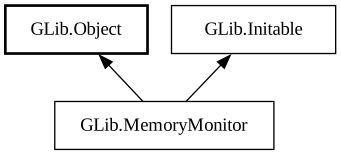
public interface MemoryMonitor : Object, Initable
MemoryMonitor
Object Hierarchy:
Description:
`GMemoryMonitor` will monitor system memory and suggest to the application when to free memory so as to leave more room for other applications.
It is implemented on Linux using the Low Memory Monitor (API documentation).
There is also an implementation for use inside Flatpak sandboxes.
Possible actions to take when the signal is received are:
- Free caches
- Save files that haven’t been looked at in a while to disk, ready to be reopened when needed
- Run a garbage collection cycle
- Try and compress fragmented allocations
- Exit on idle if the process has no reason to stay around
- Call [`malloc_trim(3)`](man:malloc_trim(3)) to return cached heap pages to the kernel (if supported by your libc)
Note that some actions may not always improve system performance, and so should be profiled for your application. `malloc_trim()`, for example, may make future heap allocations slower (due to releasing cached heap pages back to the kernel).
See [type@Gio.MemoryMonitorWarningLevel] for details on the various warning levels.
```c static void warning_cb (GMemoryMonitor *m, GMemoryMonitorWarningLevel level) { g_debug ("Warning level: d", level); if (warning_level > G_MEMORY_MONITOR_WARNING_LEVEL_LOW) drop_caches (); }
static GMemoryMonitor * monitor_low_memory (void) { GMemoryMonitor *m; m = g_memory_monitor_dup_default (); g_signal_connect (G_OBJECT (m), "low-memory-warning", G_CALLBACK (warning_cb), NULL); return m; } ```
Don’t forget to disconnect the [signal@Gio.MemoryMonitor:GMemoryMonitor:low-memory-warning] signal, and unref the
`GMemoryMonitor` itself when exiting.
Namespace: GLib
Package: gio-2.0
Content:
Static methods:
Signals:
Inherited Members:
All known members inherited from class GLib.Object
All known members inherited from interface GLib.Initable